|
MAC Interview - by M.O. - Feb. 10 2009
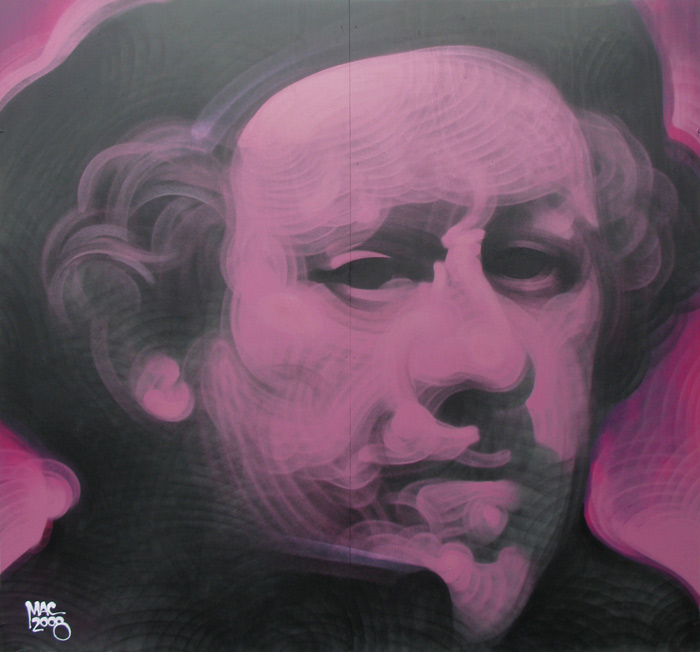
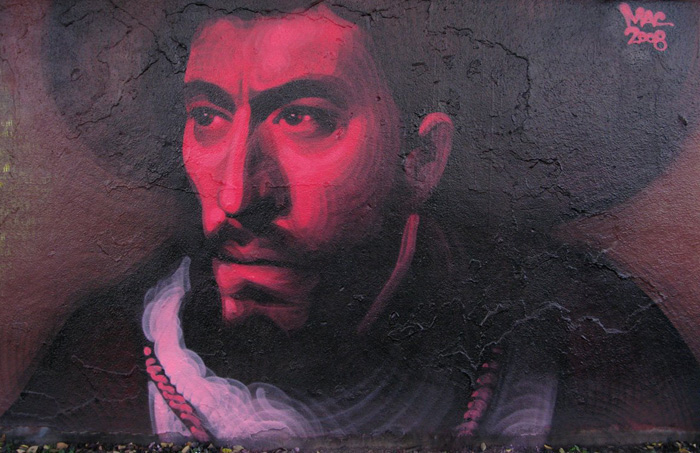
The Mac is quite possibly this generation's Michelangelo. At the very least, he is the graffiti community's Michelangelo. He spends his time traveling the world to paint photorealistic portraits with spray paint. He has been doing this for a number of years now, and his current work is proof that he is still innovating and evaluating his work.
Photorealism is nothing new to any of us. In the world of fine art, it is what most artists strive for. And in the world of graffiti art, the story is the same. There are a few artists around the world that can do it well. But when looking at The Mac's work, it stands apart from the rest. His work is iconic and his execution is different. You can tell it's a Mac piece when you're looking at it. His art is important because he is pushing the boundaries of what is possible with spray paint and in graffiti. He continues to inspire and motivate artists all around the world.
We had a chance to interview him recently and here is what he had to say.
Art Primo: What do you write and how long have you been writing?
MAC: I write Mac, sometimes elmac or themac for more letters. Painting
graffiti since '95.
AP: Do you represent any crews? What are they and how long have you been
down?
MAC: I'm down with a few crews. Nuestra Gente is based out of Phoenix,
known for painting trains. UTI is an OG LA crew. 7th Letter is
probably the most well known these days.
AP: How would you describe your style of art?
MAC: Realism with soul.
AP: What influences did you have when you first started?
MAC: My mom and Alphonse Mucha above all. Caravaggio, Vermeer, Moebius. A
lot of comic book stuff. Religious art. Pin-ups.
AP: How often do you travel to paint?
MAC: Getting to be pretty often. I was fortunate enough to have the
opportunity to go to a lot of places last year. Puerto Rico, Korea,
Italy, Holland, Montreal..
AP: Have you had any close calls with authorities while painting? And can you
tell us one of those stories?
MAC: Yeah I've had a few, but nothing too crazy and nothing I'd wanna
glamorize. Running across busy freeways, getting shot at, lots of
running & hiding, climbing over barbed wire fences, hiding from cops.
A bunch of dumb risks, when I should have been safe at home making
stencils or something. Just kidding!
AP: How do the authorities approach graffiti where you live? And do you feel
that it helps clean the streets or encourages more vandalism?
MAC: I live in Phoenix and things are very controlled there. Things usually
don't stay up long, there's a lot of negative public sentiment, not
very art-friendly. The streets are pretty clean I suppose, but a
little soulless too. It's a big city and no matter what they do
there's always gonna be kids painting graffiti. By fighting graffiti
so well, the result is that the stuff you do see is often not that
great. There are some really talented writers, but overall the bar is
low. I remember being younger and desperate to find places to paint. I
would paint the most cutty hidden spots that nobody would ever see
unless they went out of their way...and it would still get buffed. I
think that kind of thing discourages kids from trying and really
putting heart & soul into their art.
AP: What makes you want to keep doing graffiti?
MAC: Just the love of the freedom of it. Of having to take chances. The
challenges. And it's a natural thing to want to earn respect, make a
name for yourself, feed the ego. Painting graffiti also is paying dues
in a way, since if some kid doesn't see me putting in work now, he
probably won't know or care if I was putting in work 14 years ago.
It's weird now though because I'm making a living off something I used
to have to go through so much crap for. It's less tempting to go risk
jail & fines painting something that might not last a day, when I have
opportunities to take my time, painting something I like in a good
spot. There's still something magic about trains though...
AP: Where do you believe the line is drawn between what is a paintable
surface and what is off limits?
MAC: I think it's been sort of tradition that homes & places of worship
should be off limits.
AP: What do you think about the current state of graffiti? And how has it
changed since you first started?
MAC: It's gotten huge, it's nuts. It's global. In the early nineties, I
guess graffiti was blowing up, but it wasn't anywhere NEAR how it is
now. The amount of paint brands and colors is just insane. I remember
I used to mix my colors a lot because options were so limited. There
was a while when the ONLY light blue you could get was Rusto Harbor
Blue, since Krylon had stopped making Baby Blue. Now there's probably
at least fifty different shades of light blue being made.
AP: Do you have any favorite colors or color combinations that you like to
paint with?
MAC: Cool colors, blues & greens.
AP: What do you get more pleasure from, piecing or bombing?
MAC: I love both but I guess I'd have to say piecing. I like taking my time
to perfect things. But bombing is good balance for that.
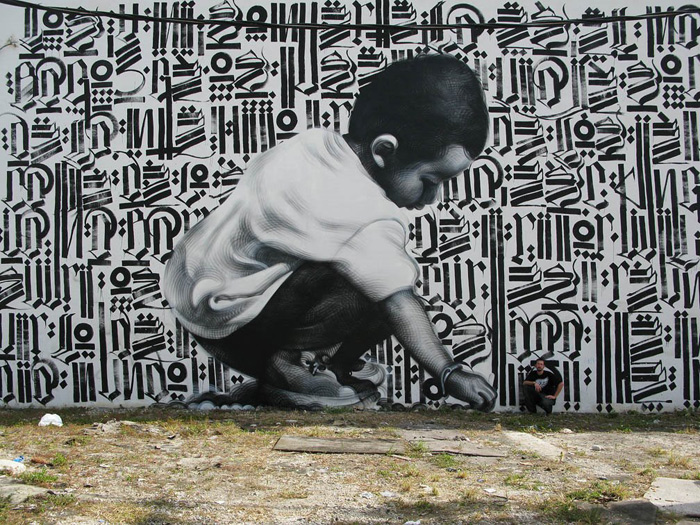
AP: You have been painting with Retna quite a bit recently. How did you hook up with him and what do you like most about your partnership?
MAC: I first met Retna around 2000 in Tijuana, and we first painted together maybe
around '03 in LA. He was taking fashion ads and painting around these
images of models with abstract lines & colors, and I had been painting
women on walls based on similar fashion models. We liked
each other's work, and it seemed to make sense to try collaborating.
We both bring different strengths & styles together and I think the
results have been really nice.
AP: Your portraits have evolved over the years. Can you describe how the
evolution occurred for you? And how would you describe your current style?
MAC: I started out very influenced by Hex TGO from LA, and just wanted to
paint stuff super smooth & realistic. That was a good foundation, and
then over the years I guess I've just been finding my own voice. The
lines and patterns I've been using came from painting faces quickly
with fatcaps in the dark.
AP: The approach you have towards painting seems to be much more grounded in
fine art than traditional graffiti. What is your artistic background?
MAC: I've been devoting my life to art since I was a little kid. My mom is
an artist, so that got the ball rolling. I never went to art school
but I studied tons of art books. I really found a lot of inspiration
in older classic art. As far as graffiti I actually came up around
very traditional writers, and I have a huge love of traditional
graffiti.
AP: Your portraits and pieces are unique and culturally rooted. What do you
look for when you pick photos to work with?
MAC: I usually try to work from my own photos, or photos taken by friends.
I just have a certain look that I go for that I'm not sure how to
describe. When I paint women I try to make them beautiful, dignified.
Going for something timeless.
AP: What projects are you currently working on? And where are you planning
to travel next?
MAC: I'm working on pieces for an upcoming show in LA with Retna & Saber.
Couple mural projects coming up. Possible book. A bunch of
opportunities I'm grateful for & excited about.
Special thanks to The Mac for taking the time to do the interview. |